

Map types
A map type is the kind of canvas you choose when you create a board. CardBoard supports a couple dozen map types today, and the list keeps growing: user story map, sitemap, kanban, persona, business model canvas, journey, four Ls retrospective, sailboat, SWOT, mind map, process map, empathy map, freeform canvas, and more.
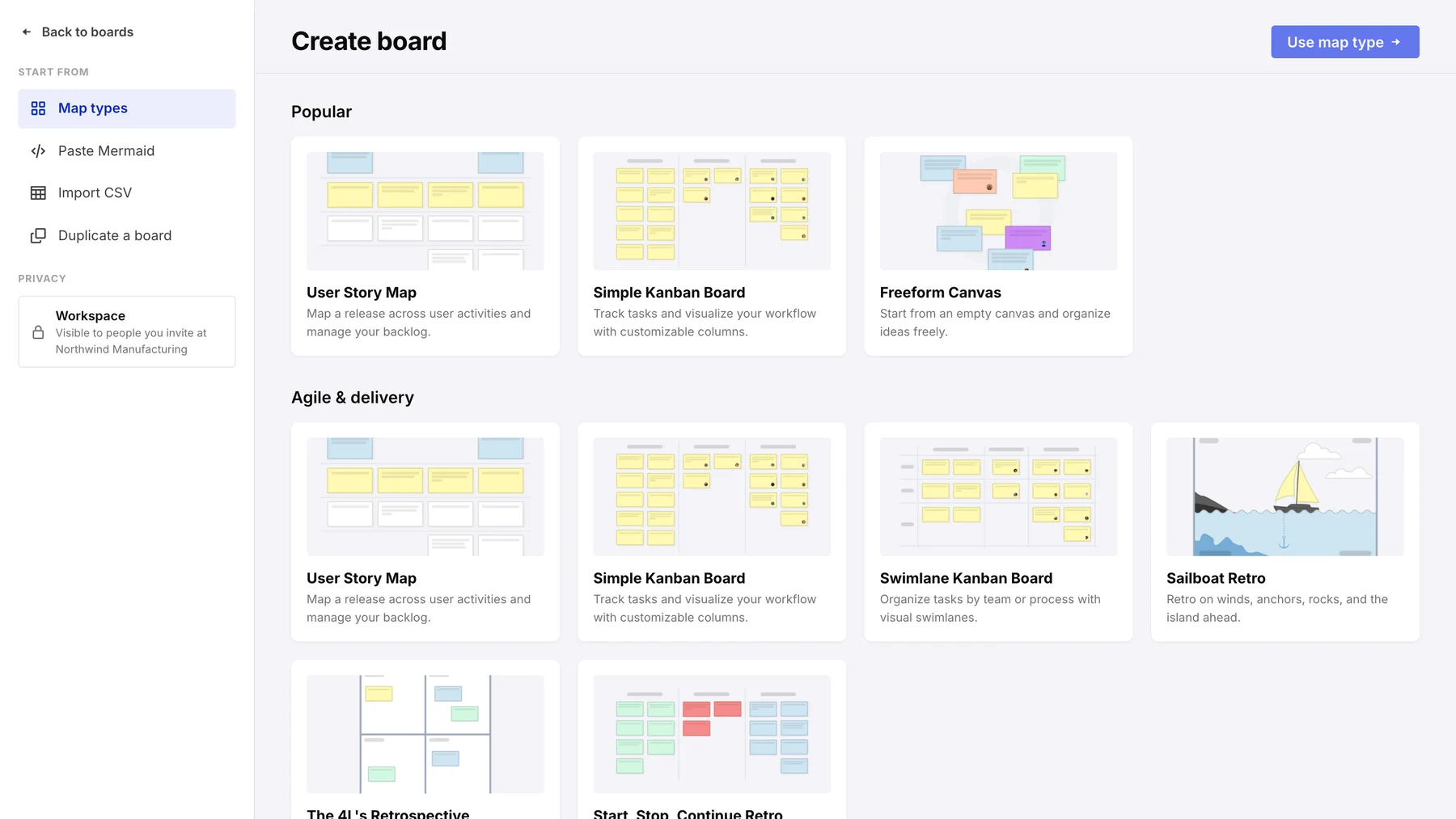
The map type tells the board how cards can be arranged, what’s structural and what’s decorative, and what kind of connections make sense. On a kanban, columns are the structure. On a sitemap, the parent–child tree is. On a freeform canvas, position is whatever you decide. The map type makes the rules.
Choose a map type when you create a board, and pick the one that matches the conversation you’re trying to have. A team starting a new feature might use a persona and a journey map to get clear on who they’re building for, then a user story map to break the solution down, then a kanban to execute — different boards, different map types, same workspace.
Underneath, every map type is described by the same four traits — component, connection, position, and landscape. A user story map and a swimlane kanban share one trait profile (cards in lanes), differing only in their labels — which is why new map types that reuse a profile are cheap (relabel and ship). For the model that makes a map typed, see Map traits.
The map type also names the boundaries that create groups: on a story map they’re slices, and each slice is an outcome. For the story map’s own moves (freezing the backbone, inserting a column), see Work on a story map.
The map type is set at board creation and doesn’t change. If you started a story map and want a kanban, create a new board; cards can be copied between boards.