

Cards
A card is the unit of work on a board. Every card carries a title, an optional description, optional status, and visual attributes (shape, color, size). Cards are what you write on, move around, color, react to, and connect.
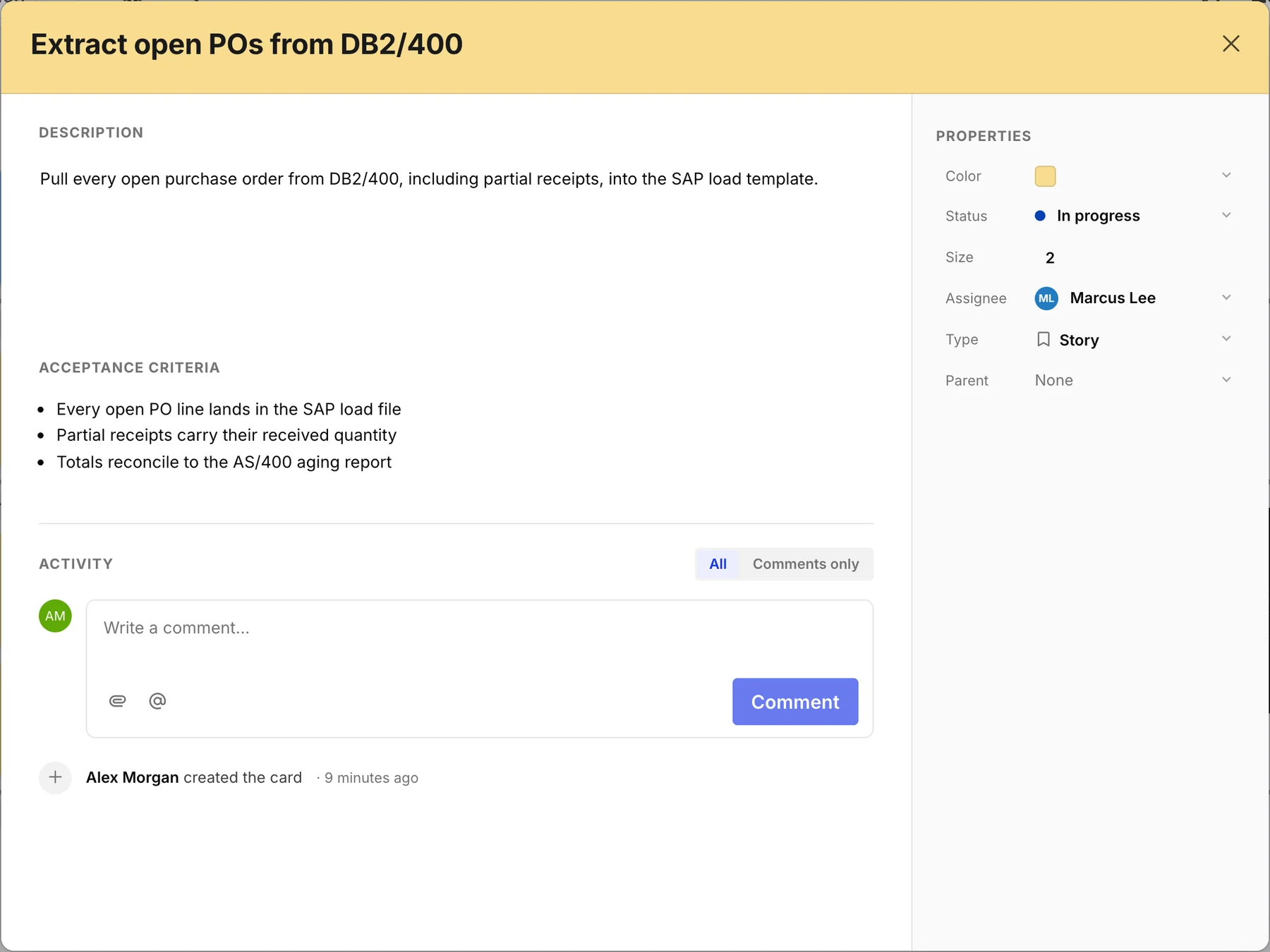
Cards exist because planning happens at the level of nameable units. A user story, a feature, a hypothesis, a question, a task — all are cards. The shape of the card tells you what kind of thing it is; the color groups cards visually without forcing them into a structural relationship.
Cards belong to exactly one board. Their position is interpreted by the map type — on a story map, position means “which step of the journey, in which release”; on a kanban, “which column”; on a freeform canvas, “wherever you put it.” The map type chooses what position means; the card itself is shape-neutral.
Cards can be linked to an external tracker. When linked, a card mirrors the tracker item’s work-item fields — title, status, description, acceptance criteria, parent, and assignee — automatically, and edits flow both ways. Sync state lives on the card↔tracker link, not on the card — so a card can move between trackers, or have none, without rewriting its data.
A card can carry:
- Reactions — lightweight emoji feedback from collaborators
- Comments — durable conversation threads
- Connections — lines to other cards (or to stickers)
- Parent and children — hierarchy on story maps and sitemaps
- Group membership — the outcome of the boundary it sits in, plus any journeys it’s been grouped into
For the complete field list, see Card properties.