

Boundaries
A boundary is a line or frame on the canvas that names and bounds a region. Boundaries are how CardBoard creates groups: every card inside a boundary’s region belongs to the group that boundary defines, its outcome. Use a boundary to group cards by what they’re about (“Discovery,” “MVP,” “Phase 2”) without making one of them the parent of the others.
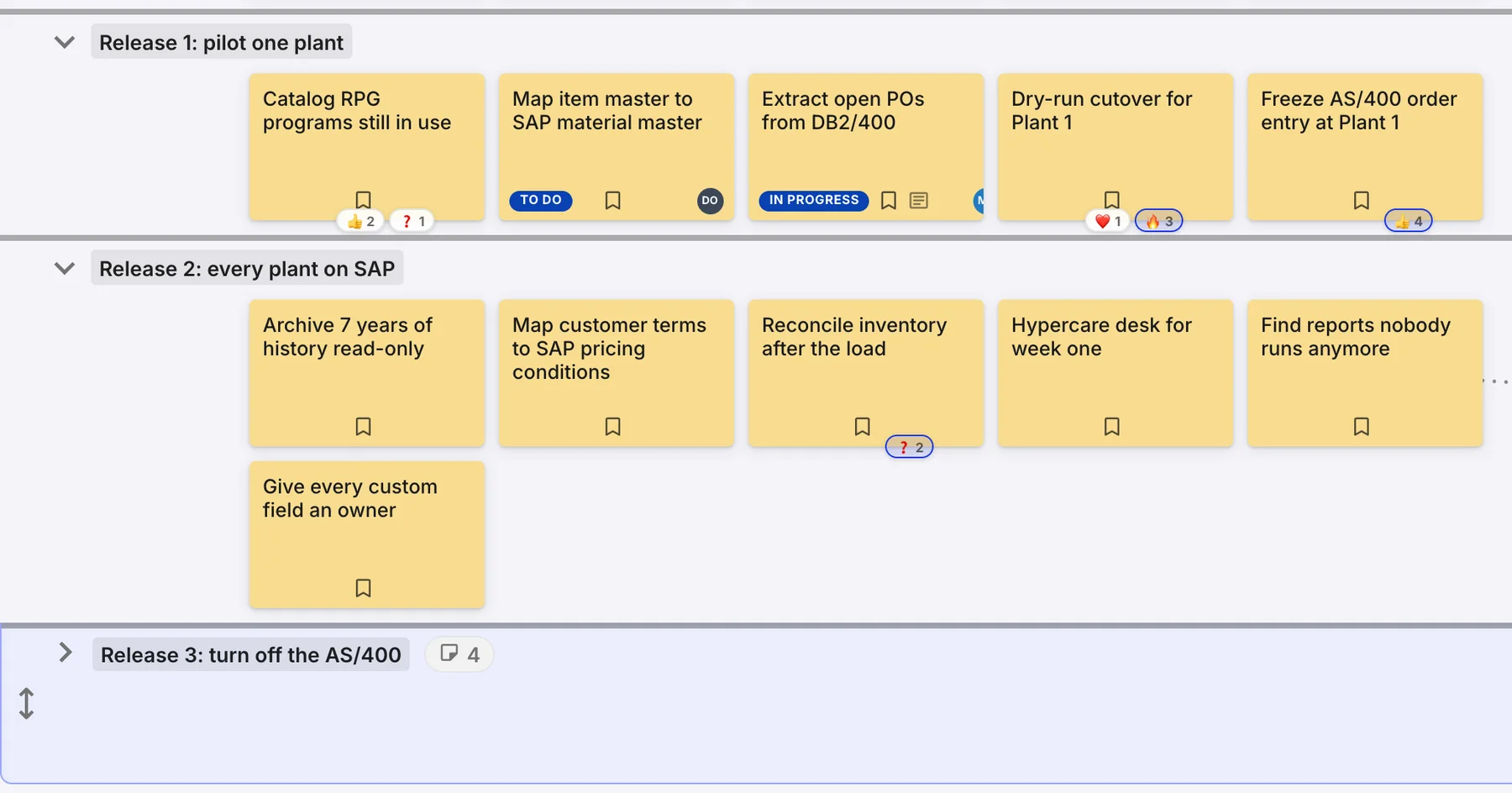
Boundaries come in two shapes:
- Line boundaries run horizontally or vertically across the canvas, cutting it into stripes.
- Frame boundaries enclose a rectangular region, bounded on all sides.
Which shape is available, and what it’s called, depends on the map type:
| Map type | Boundary | What it marks |
|---|---|---|
| Story map | Slice, a horizontal line | A release |
| Canvas zones (persona, business model canvas) | Frame | A zone |
| Tree map | Line | A depth |
Slices on a story map
Section titled “Slices on a story map”On a story map, boundaries are called slices. A slice is a horizontal line across the map, below the backbone. Everything between it and the next slice down is that slice’s region, and each slice is an outcome: name the slice “Release 1: pilot one plant” and every card in its region belongs to that outcome. Drag a card into a slice and it joins; drag it out and it leaves.
For the rest of the story map layout (the backbone, freezing its row, and inserting columns), see Work on a story map.
Boundaries define outcomes
Section titled “Boundaries define outcomes”A boundary’s name is the name of the outcome it creates. Rename one and the other follows. Membership comes from position alone: there’s nothing to tag or file.
That’s the difference from a journey, the other kind of group. A journey is a set of cards you select and group by hand, with no region on the canvas. A card can sit in a slice’s outcome and belong to any number of journeys at once.
Collapsing
Section titled “Collapsing”A line boundary’s section can be collapsed to fold away the cards beneath it and expanded to bring them back. On a long story map, collapse the slices you’re not working on to keep the map readable. A collapsed section is collapsed for everyone on the board. Collapsing hides cards; it doesn’t change their group membership or delete anything.
Deleting a boundary
Section titled “Deleting a boundary”Delete a boundary and the outcome it defined goes with it. The cards stay where they are on the canvas; they just no longer belong to that outcome. Journeys aren’t affected: a card keeps every journey it was grouped into.
A boundary is not a card. It’s lighter, with no description, no status, no tracker link, and no reactions. It exists to label and bound, not to hold work.