

Boards
A board is the named, ownable thing you and your team collaborate on. Every board lives in a workspace, has a name, has collaborators (managers, editors, viewers), and contains one map — the canvas where the work happens.
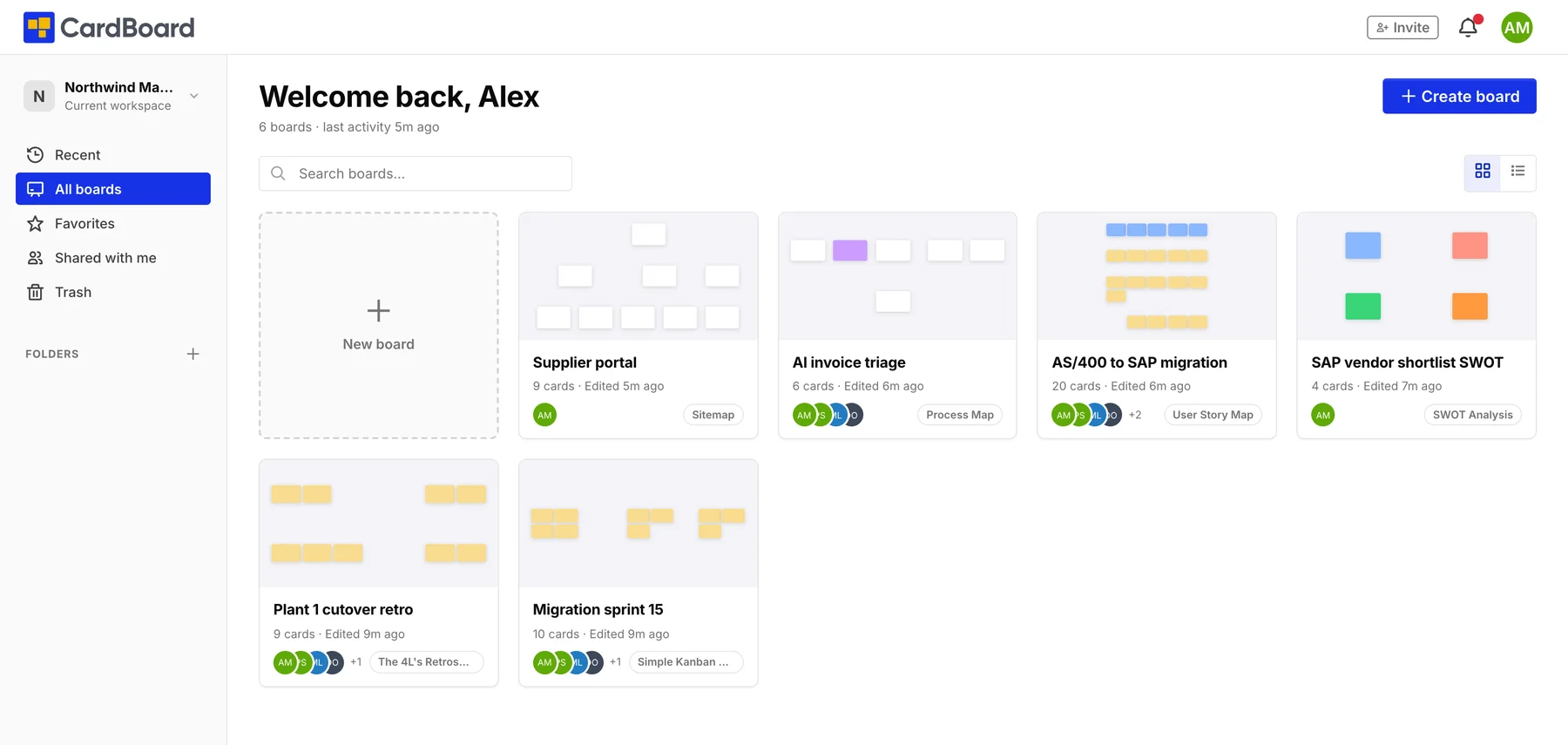
Boards are the unit of ownership and access. “I created a board for our Q3 planning”; “share the roadmap board with the design team”; “archive the old discovery board.” Sharing, renaming, duplicating, archiving, and exporting all happen at the board level. Permissions and notifications attach here.
Inside the board, the map is the canvas. The map has a type — story map, sitemap, kanban, persona, and others — and the type determines the canvas grammar (how cards can be arranged, what’s structural and what’s decorative). The board is the container; the map is what you draw on; the map type is what kind of drawing it is.
A board belongs to exactly one workspace. The workspace decides who can be a member, who’s a guest, what features the board has access to, and who pays the bill. Within the board, collaborators have a role that decides what they can do.
Boards can connect to one external tracker (Azure DevOps, Jira, Linear, Shortcut, or Trello). When connected, cards on the board can mirror tracker items, and edits flow both directions. The connection is at the board level — a board has at most one tracker, and a tracker connection can’t span boards.
A board’s background is cosmetic: from the board’s settings you can set a light or dark theme, or one of a handful of accent colors (blue, yellow, orange, green, purple, pink). It changes appearance only — it doesn’t affect cards, the map type, or what syncs.