Customer discovery lessons from Airbnb and The Mom Test
In 2009, Airbnb was making about $200 a week. It had been making about $200 a week for eight months.
The founders were in Y Combinator at the time, and they sat down with Paul Graham to look at their New York listings. The problem wasn’t the code. It was the photos. Hosts had shot their apartments on camera phones, or borrowed pictures from classified sites. You couldn’t tell what you’d be sleeping in, so nobody booked.
Graham’s advice was not to write a photo-quality algorithm. It was to go to New York.
So Brian Chesky and Joe Gebbia flew there, rented a camera, and knocked on their hosts’ doors to photograph the apartments themselves. A week later, weekly revenue had doubled, to $400.
$400 a week is not, by most definitions, a unicorn. But it was the first number that had moved in eight months, and it moved because two founders stood in their customers’ apartments instead of guessing about them from a laptop. Gebbia later called it the first time anyone gave them permission to do things that don’t scale.
That trip is customer discovery. The rest of this post is how to do it on purpose.
Customer discovery is step one of four
Customer discovery is the practice of turning your guesses about customers into hypotheses, then testing them by talking to real people before you build. It answers four questions. Who has this problem? How do they deal with it today? What does it cost them? Would they switch?
The term comes from Steve Blank. Between 1978 and 2002 he worked at eight technology startups and founded or co-founded four of them. The last was E.piphany, which he co-founded in 1996 and left the day before its IPO in 1999. Then he started teaching, at Berkeley from 2003, and wrote down what he thought the eight startups had taught him.
The book was The Four Steps to the Epiphany (2005). The title is a nod to his old company. The thesis is that startups rarely fail because they can’t build the product. They fail because nobody buys it.
Blank’s model, Customer Development, runs in four steps: customer discovery, customer validation, customer creation, and company building. Discovery is where you write down your hypotheses about the customer, the problem, and the product, then get out of the building and test them. Validation proves there’s a repeatable way to sell. Creation builds demand on purpose, and company building turns a group that learns into one that operates.
Discovery comes first because every later step inherits its mistakes. If you’re wrong about who has the problem, you’ll validate the wrong sales process and build demand among the wrong people, very efficiently.
The investor who assigned homework
In 2004, Eric Ries and Will Harvey asked Blank to invest in their startup, IMVU. He agreed on one condition: they had to take his Customer Development class at Berkeley’s Haas School of Business.
It’s the rare term sheet with a reading list. It worked. Ries paired Blank’s customer discovery with agile engineering, shipped and measured constantly at IMVU, and later wrote the result up as The Lean Startup (2011). Its core loop is build, measure, learn.
Customer discovery is where you decide what “learn” means. Before you build anything, you name the assumption that would sink you if it were wrong. Then you go find out whether it is.
Everyone is lying to you, politely
Here’s the catch. When you ask people about your idea, they’re nice to you.
Rob Fitzpatrick’s The Mom Test (2013) is about that problem. The title comes from the idea that your questions should be good enough that even your mom couldn’t lie to you with her answer. Your mom loves you, which is exactly the problem: she’ll tell you the app sounds great, and she will never download it.
Fitzpatrick’s rules come down to three:
- Talk about their life, not your idea. The moment you pitch, you get compliments instead of data.
- Ask about specifics in the past, not opinions about the future. People are bad at predicting what they’ll do. They’re pretty good at remembering what they did.
- Talk less, listen more. If you’re talking, you’re not learning.
In practice, the difference looks like this:
| Question that gets you lied to | Question that gets you data |
|---|---|
| Would you use a tool that does X? | When was the last time you dealt with X? |
| How much would you pay for this? | What have you already spent trying to fix it? |
| Is this a big problem for you? | What did you do about it last time? Walk me through it. |
| Do you like the idea? | Who else should I talk to about this? |
The last row matters more than it looks. Fitzpatrick’s test for a good meeting is whether it ends in some kind of commitment: time, a reputation on the line, money. An introduction to a colleague costs them something. A compliment costs nothing, which is roughly what it’s worth.
Blank’s method vs. The Mom Test
They agree on the principle and differ on shape. Blank’s method is a structured program: written hypotheses, a sequence of phases, exit criteria before you move to validation. The Mom Test is a conversational discipline you can apply in any conversation, formal or not, including the one at a party where someone asks what you’re working on.
You want both. Blank tells you what to test. Fitzpatrick keeps the test honest.
Running discovery as a loop
Discovery is listed first, which makes it sound like something you finish. In practice you keep running it, each time at a smaller radius. Here’s the loop, with the judgment calls marked.
- Write your assumptions down before the first interview. Who has the problem, how they handle it today, why they’d switch. The judgment call: rank them by how badly you’d be hurt if they were wrong, and start with the worst one. In hindsight, Airbnb’s was something like “people will book a stranger’s apartment from a bad photo.”
- Test them with interviews about the past. Open-ended questions, specific incidents. If you catch yourself describing your product, stop.
- Sort what you heard. Separate facts (what they did), feelings (what frustrated them), and fluff (what they say they’d do). Only the first two count.
- Refine the idea. Change the product, the customer, or the problem statement. One of them usually has to give.
- Repeat. The judgment call here is when to stop a round: when new interviews stop surprising you, you’ve learned what this round can teach. Go test the next assumption.
Where the interviews go afterward
The failure mode after a round of interviews is a folder of notes nobody reads twice. Discovery only pays off when the team can see the pattern, and a pattern is easier to see on a wall than in a doc.
CardBoard has three map types built for this.
A Customer Interview Timeline lays one interview across the four Jobs to Be Done decision phases: Passive looking, Active looking, Deciding, Consuming. Each moment the customer described becomes a card in the phase where it happened. Put three interviews side by side and the shared moments line up on their own.
A Four Forces (JTBD) map sorts what pushed them to switch against what held them back: Push of the Situation, Pull of the New Solution, Habit of the Present, Anxiety of the New Solution. If you only hear about push and pull, you haven’t asked about the switch yet.
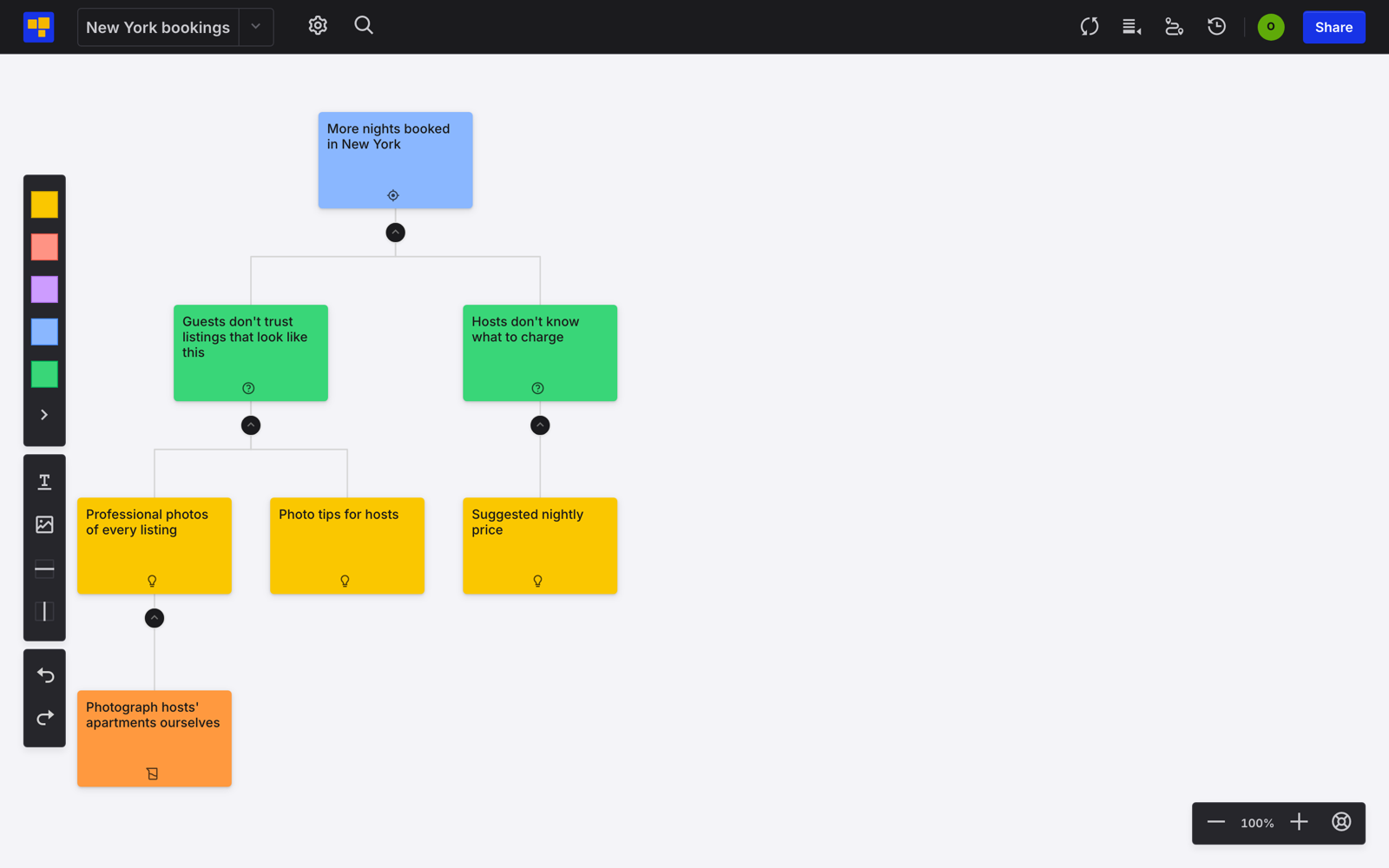
An Opportunity Solution Tree turns the whole thing into a plan. The outcome you want sits at the root. The opportunities you heard in interviews hang under it, then the solutions, then the experiments that test them. CardBoard knows the grammar: if you hang a solution directly under the outcome without an opportunity in between, it flags it.
Airbnb’s New York trip fits on one branch. The outcome is more nights booked in New York. The opportunity is that guests don’t trust listings that look like these. The solution is professional photos. The experiment is two founders and a rented camera.
Where I start now: the transcript
Here’s how I do this at CardBoard today. I use boards to capture market research that I conduct with AI. And when I have an interview transcript, I give it to Claude, and through CardBoard’s MCP connector it generates a new board from it: a Customer Interview Timeline, a Four Forces (JTBD) map, or a User Story Map, depending on what I’m trying to learn.
The first sort is the machine’s. The pattern across interviews is still yours to find, and it’s a lot easier to find on a board than in three transcripts.
If you want the qualitative side in more depth, an empathy map is a good next board. And once discovery gives you something worth measuring, the product metrics guide picks up where this one stops.
We do this too
We run customer discovery on CardBoard, and I’d like to interview you. Start a free trial, then message us through the chat inside the app and say you’re up for it. I promise to ask about your past and not pitch you anything, which is a strange promise to make while you’re in a free trial, but there it is.