How to run a 4Ls retrospective, step by step
Picture the end of a two-week sprint. Seven people, one board, four quadrants. Five minutes in, the “Lacked” quadrant has eleven cards. “Liked” has two, and one of them says “pizza.”
That’s a normal first pass, and it’s the reason the 4Ls exists. A retro that only asks “what went wrong?” gets a list of complaints. A retro that asks four slightly different questions gets something you can act on.
The 4Ls was created by Mary Gorman and Ellen Gottesdiener, two consultants who work with agile teams on requirements. The four questions are simple:
- What did we like?
- What did we learn?
- What did we lack?
- What did we long for?
The design choice that matters is the split between the last two. “Lacked” looks backward at what was missing. “Longed for” looks forward at what would have made it better. They sound like the same question until you run the retro and watch people sort their cards.
What the 4Ls retrospective is for
The 4Ls is a sprint retrospective format. At the end of a sprint, the team looks back at how it worked, not what it built, and decides what to change. The Agile Manifesto’s twelfth principle asks for exactly this: at regular intervals, reflect on how to become more effective, then adjust.
It’s a good fit when:
- the team’s retros have gone stale and people are giving the same answers every time
- the sprint had both clear wins and clear problems, and you want both on the table
- the team is new, and you want a format that’s easy to explain in one sentence
It runs comfortably in 45 minutes to an hour for a team of five to nine. Allow more time for larger teams, or for a sprint that went badly.
How to run a 4Ls retrospective
Step 1: Set the expectation
Before anyone writes a card, say what the retro is for and what it isn’t for. It’s for improving how the team works. It’s not for deciding whose fault anything was.
Norm Kerth’s Retrospective Prime Directive is a good thing to read aloud here. The core of it is that “everyone did the best job they could,” given what they knew at the time. If the sprint was tense, say so plainly. Pretending it wasn’t makes the rest of the retro harder.
Step 2: Set up the board
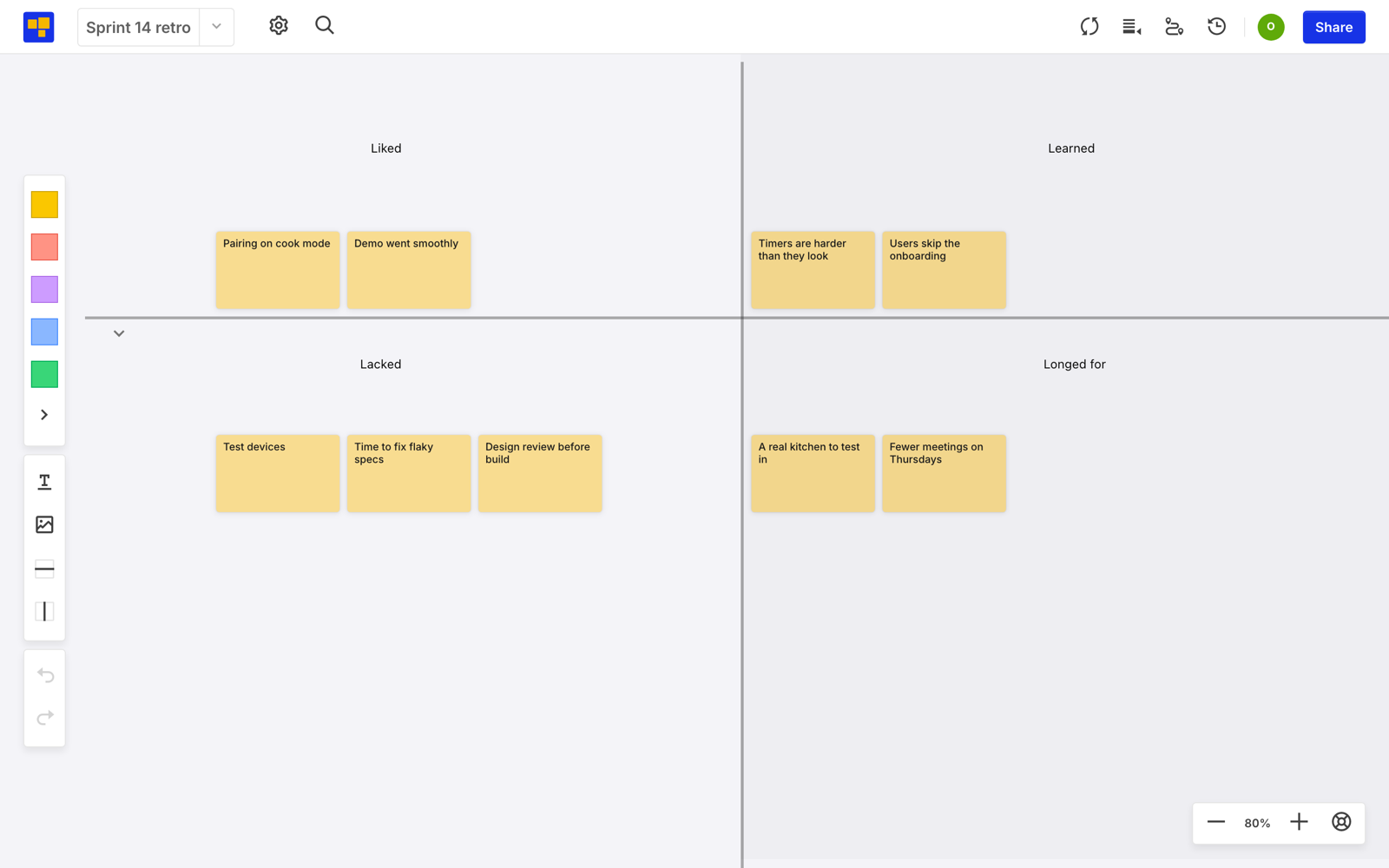
Put the four quadrants up where everyone can add to them at once. On a physical wall that’s four sheets of paper. For a remote or hybrid team, use a shared board where everyone writes their own cards.
In CardBoard, create a board and choose The 4L’s Retrospective as the map type. You get a board split into four quadrants, already labeled Liked, Learned, Lacked, and Longed for. Invite the team to the board before the meeting so nobody spends the first five minutes looking for a link.
Step 3: Write silently first
Give everyone five to seven minutes to add cards to all four quadrants without talking. One idea per card.
This is the easiest step to skip, and it matters most for the quieter people. If the discussion starts before the writing is done, the first two opinions in the room shape everyone else’s cards.
Step 4: Walk through Liked
Read the Liked cards together. Group duplicates by moving them next to each other.
For each group, ask why. “The pairing sessions” is a nice card. “Pairing meant nobody got stuck for more than an hour” is a finding, and it tells you what to protect next sprint.
Step 5: Walk through Learned
Learned is where the useful surprises tend to be. It covers technical lessons, lessons about the product, and lessons about how the team works.
No lesson is too small here. “The staging database resets on Mondays” might save someone a day next sprint.
Step 6: Walk through Lacked, then Longed for
Take these two together, in order.
Lacked is what was missing: information, time, access, a decision someone needed and didn’t get. Keep the discussion on the gap, not the person. If a card is really about one person, it belongs in a private conversation, not the retro.
Longed for is what would have made the sprint better. Here’s where the split earns its keep. If a Lacked card says “requirements kept changing,” the matching Longed for card might say “a fixed Sprint Goal.” The first is a complaint. The second is a proposal. You can usually turn one into the other by asking “what would have fixed that?”
In CardBoard, anyone can react to a card with an emoji. A thumbs-up is a quick way to say “me too” without anyone writing a duplicate card, and it shows the facilitator where the room already agrees.
Step 7: Pick actions and give each one an owner
This is the step that decides whether the retro was worth an hour.
Pick one to three changes for the next sprint. Not ten. Each one gets an owner and a specific first step. “Improve communication” is not an action. “The Scrum Master posts the Sprint Goal in the team channel on day one” is.
Then put the actions where the team will see them during the sprint. An action item that only lives on the retro board is an action item nobody will look at until the next retro, when it will be discovered, briefly regretted, and copied to the new board.
In CardBoard, select the action cards on the retro board and copy them with Ctrl or ⌘ + C. Open the team’s story map or Kanban board and paste with Ctrl or ⌘ + V. The copies land next to the rest of the sprint’s work, and the originals stay on the retro board as the record.
Tips for a better 4Ls retrospective
Keep the facilitator out of the writing. If you’re running the retro, you’re there to keep time and ask “why,” not to add your own cards to every quadrant.
Rotate the facilitator every few sprints. The same person running every retro starts to shape what gets said.
For remote retros, ask people to close chat and email for the hour. Cameras are optional. Attention isn’t.
Start the next retro by checking last retro’s actions. If none of them happened, that’s the first thing to talk about.
Don’t use the 4Ls every time. Any format goes stale if you run it every two weeks for a year. CardBoard also has Sailboat and Start, Stop, Continue retro boards if you want to rotate.
When to use a different format
The 4Ls is good at getting a balanced picture of a sprint. It’s less good at digging into one specific problem. If the team already knows what went wrong and needs to understand why, a focused root-cause discussion will get there faster than four quadrants.
For more on where retros fit in a sprint, see Agile sprints: how to run one without burning out your team.
The four quadrants will be empty again in two weeks. The point is that the Lacked quadrant fills up a little slower.